
Introduction
Over the past few months, we honored the many talented artists who captivated us with their films, music, and podcasts. With the expansion of award categories at the Golden Globes and the Emmys, it seems that all forms of content – even podcasters – now have a forum to showcase their best and brightest. Still, one group of storytellers remains unrepresented on the star-studded red carpet: policymakers.
At first glance, bespeckled policy wonks and civil servants seem like the worst candidates for an Oscar. After all, how many award-winning scripts contain detailed diplomatic stratagems for a multipolar world or multivariable regressions assessing the impact of trade exposure on wages in the automotive industry? Nevertheless, effective, ethical public policy shares the same artistic foundation as filmmaking, literature, and music: good storytelling.
Panels in a Storyboard
Like a novel or a script, public policy is rooted in narratives that succinctly explain complex concepts or observable phenomena. Just as the late Rob Reiner combined written and visual storytelling to comment on the finer points of platonic (or not-so-platonic) love in “When Harry Met Sally,” IMF economists painstakingly piece together formulas, spreadsheets, and graphs to tell us the global growth outlook for the next year. In economics, indicators inform deductive storytelling, serving as panels in a storyboard that showcases the larger macroeconomic picture.
A bottom-up approach to policy storytelling uses observable data to identify and solve problems. Modern economics emerged from new indicators, such as gross domestic product (GDP) and the unemployment rate, which distilled disparate lived realities into digestible, aggregated figures. From the 1930s onward, policymakers could assess the economy’s overall health with mathematically robust snapshots and prescribe and monitor policies to alleviate mass unemployment, deflationary spirals, and credit shocks.
At the height of the Great Depression, economic indicators revealed a story that classical models failed to capture: severe market failures may not resolve themselves on human time scales. Economic luminary John Maynard Keynes once remarked: “The long run is a misleading guide to current affairs. In the long run, we are all dead.” Deductive reasoning and the spread of data justified increased government intervention in the economy and gave presidents and central bankers the tools to communicate improvements in overall welfare to both experts and the public. Just as the New Deal relied on credible data and skilled economists to unwind the Great Depression, it also relied on creative storytellers – most notably, President Roosevelt – to restore public confidence.
Data and statistics, though sometimes flawed in scope and accuracy, are the bureaucratic language of policy storytelling. We are no longer surprised to hear inflation data or monthly jobs reports cited as justification for entitlement programs, economic stimulus, or interest rates. Fed Chair Jerome Powell’s measured “Good afternoon” and evidence-based speeches at the Federal Open Market Committee meeting demonstrate how mundane yet informative storytelling stays vital to economic policy. However, what happens when data is poor or nonexistent? How can policymakers uncover, create, and use stories to inform policy?
Tropes in a Script
In the social sciences, theory often serves as a heuristic for understanding the world when empirical evidence falls short of the whole story. Unlike molecules and cells, humans are complex organisms that do not lend themselves to precise modeling or to time-tested rules. Countries are even more difficult to model. After all, they are large units comprising not a single fickle human, but millions. This is where top-down storytelling, grounded in theory, comes into play.
In the field of international relations, theory and political philosophy combine with historical case studies to shape the narratives that drive foreign policy. In International Relations 101, professors introduce students to three main schools of geopolitical thought:
Realism assumes that rational, self-interested states and their constant pursuit of power drive international politics in a Hobbesian, conflict-ridden, anarchic world. Every summit, trade agreement, and alliance is not an indicator of benign cooperation but a tool states wield to expand their power or check their rivals. The Peloponnesian War and the Cold War, both conflicts between two great powers, are considered exemplary cases that vindicate realism.
Liberalism holds that states can cooperate to resolve shared problems. Rather than power being the sole motivator, states recognize mutual benefits from international engagement, trade, and interdependence. Examples of liberalism include the evolution of the European Union and U.S. preeminence in the 1990s, as well as the now-defunct “Golden Arches” theory of conflict prevention.
Constructivism argues that ideas, norms, identities, and other socially constructed elements, rather than power or economic interests alone, shape global politics. Mikhail Gorbachev's “New Thinking,” which redefined Soviet identity and interests, is often cited as an example.
Each school uses data and fills gaps with assumptions grounded in philosophical or anecdotal claims, ultimately forming a top-down theoretical framework that policymakers and academics apply to world events. Given a single geopolitical event, such as the fall of the Soviet Union, we can use these theories to identify distinct causal mechanisms and policy recommendations:
Realists cite the Soviet Union’s failure to compete with U.S. military power as the main cause of its collapse. This “Reagan won the Cold War” or “Peace through strength” narrative has fueled neoconservative policies focused on maintaining U.S. military strength in a post-Cold War world.
Liberals view the fall of the Soviet bloc as a byproduct of economic isolation, central planning, and weak democratic institutions. In the 1990s, market and political liberalization, along with global openness, were seen as solutions for the Global South, with mixed results.
Constructivists attribute the end of the Cold War to Gorbachev's "New Thinking," a generational normative shift from confrontation to common security, from centralization to perestroika, and from repression to glasnost. While debate continues over how much Gorbachev “humanized” communism, constructivists emphasize that global norms and values, particularly those institutionalized by the United Nations, influence state behavior.
Each theory of geopolitics is both insufficient and robust in its own way. Realism and liberalism, although highly predictive over long historical periods, regularly fail when human rationality breaks down. On February 24, 2022, Putin invaded Ukraine, a country with dense economic ties to Russia, and launched a full-scale war that ultimately eroded Russian power rather than enhanced it. Likewise, although holistic and accurate as a descriptive tool, constructivism has poor predictive power. Constructivism explains how Putin (“bunker grandfather”) developed a warped savior complex and abandoned material rationality during the COVID-19 lockdown. Still, it failed to predict when Putin would invade until Ukrainian Bayraktars had already stalled the first Russian convoys.
Theory is a lens through which policymakers analyze events when information is incomplete; it helps us fill data gaps, especially when patterns are repetitive and predictable. However, a theory void of explicit assumptions or qualifying statements about its applicability can be dangerous. Theories appeal to our desire to know precisely how the world works, particularly when they confirm our established beliefs or preferred actions. Like the repeated tropes about unrequited love in rom-coms, we are vulnerable to conflating educated guesses (some data-based fiction) with the truth, often to our own detriment or, for government officials, to the country as a whole.
Storytelling and Policy Directors
All policies – good or bad – are products of storytelling.
The narratives policymakers construct shape how we maintain national security, improve living standards, and grow. Unlike their Hollywood counterparts, “policy directors” (policymakers) measure their craft not by views or box-office returns, but by the number of new mom-and-pop businesses created, the number of starving children fed, and the number of lives saved. Data and theory provide the panels and tropes for constructing narratives. However, the ethics of developing a story – what to include, how to present it, what to omit – carry consequences beyond Davos plenaries and D.C. situation rooms.
Good policy directors balance data and theory, aware of the limitations of each. They acknowledge uncertainty, are transparent about their motives, and are poised to adapt their thinking in light of new information. They engage with the public they represent and know how to communicate their recommendations across political ideologies, geographies, and backgrounds.
Bad policy directors form inflexible opinions without reviewing their assumptions or the available information. They are quick to conflate a compelling story with truth and slow to admit they are wrong. They know how to persuade those who already agree with them, but they are combative toward dissent. Worst of all, bad policy directors may have ulterior motives and use storytelling for self-aggrandizement and manipulation.
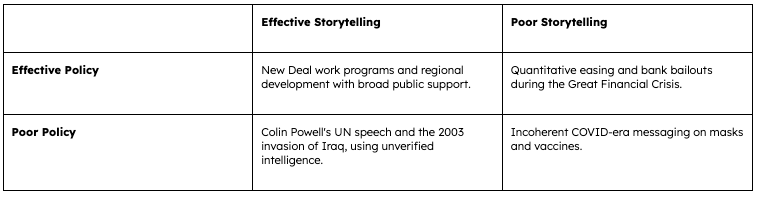
In an age of misinformation, low trust, and political polarization, media literacy and healthy skepticism are essential. Citizens should ask their representatives when they do not understand a policy, and policymakers should be prepared to explain their positions, rationales, and the data they rely on—including any limitations. If we are given a theory, we must demand empirical evidence: wage data, jobs created, and threats neutralized. If we are given a sea of numbers, it is our duty to seek a theory: How will airstrikes ensure regional security? Why will student loan forgiveness improve the economy? Why should we institute rent freezes? However, if we are given sound information that contradicts our preconceived notions, we must, as any good policy director would, be open to revising our views.
Policy wonks may never grace the Oscars red carpet, but their craft deserves the same praise and scrutiny we afford to art. The world is too beautifully complicated for boring scripts with simple plots. Great films feature astounding casts and dedicated writers who enrich our lives with vivid depictions of the human experience. Great policies engage, educate, acknowledge complexity, and evolve. Year after year, great films move us. And year after year, great policies can move the country forward if we continue to demand high standards.